Home Home
Sign up | Login

Author Archive

openSUSE Boosters at FrOSCon, Day 2

August 22nd, 2010 by

Back home in Nuernberg now – Sunday has been a long day of hacking on Elgg and its plugins to shape it into a users site that knows about the social side of the openSUSE community.

Our ‘Hack Meck’ was a little bit harder after letting loose at the legendary FrOSCon Saturday night party in the balmy August air, but we still managed to put down the glow sticks, hammer the keys and reach our goals for the weekend. These were adapting the user data to include fields that are peculiar to openSUSE such as membership status and IRC cloak, enhancing the Poll plugin to meet our info gathering needs, adapting the Elgg theming to our ubiquitous Bento theme, and working on calendaring and events so that we all know what is coming next in openSUSE world and so you can display your packaging and bug-reporting achievements to the world.

When we weren’t making like a bunch of web developers, we mingled in the exhibition area, presented our project to anyone who came by the Hack Meck room and generally enjoyed seeing the diverse projects that come to FrOSCon. Thanks go to the FrOSCon organizers for making us so welcome and to the openSUSE booth staffers for doing a terrific job – we look forward to doing it again next year.

openSUSE Boosters at FrOSCon, Day 1

August 21st, 2010 by

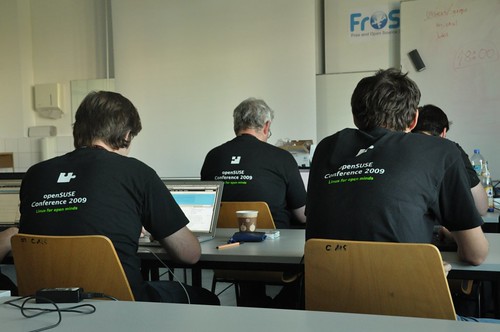
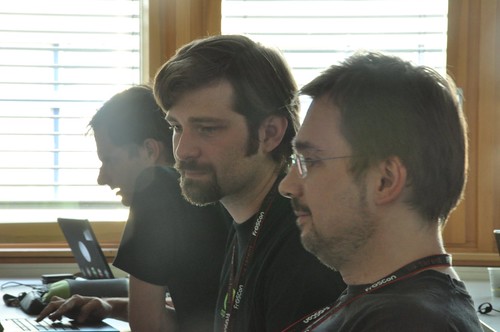
After long drives from Nuernberg, Prague and Darmstadt hitting every traffic jam on the A3 (the Czechs won the race), the openSUSE Boosters met up in the little rhenish town of Sankt Augustin near Bonn to attend FrOSCon.  Last night we reacquainted ourselves with each other and the odd glass of Kölsch or two over steak and chips.  Suitably fortified, we are now occupied our project room upstairs at FrOSCon (room C125) and are now hacking like crazy on our team project, a new site for openSUSE users and contributors.  This is based on the Elgg free software social networking platform, so we’re dusting off our PHP and looking at all the integration points with the rest of the openSUSE platform: the Build Service, Bugzilla, the wiki, Lizards, and so on. So if you’re more of a web monkey than a distro gibbon and would like to help, drop by tomorrow or just get in touch with the  http://en.opensuse.org/openSUSE:Boosters_team.

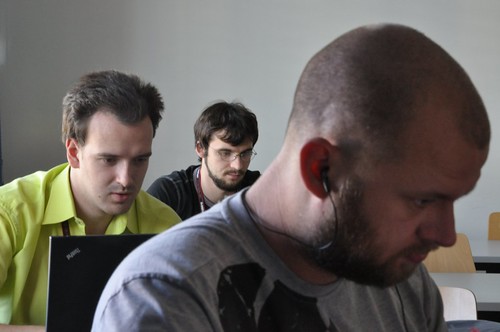
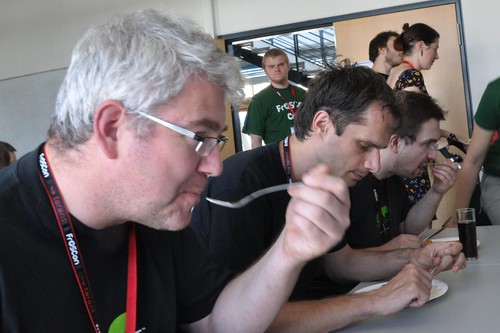
I took a few photos of us in action today, following the three-of-a-kind motto:

DSC_2818.JPG

DSC_2814.JPG

DSC_2801.JPG

dindins.JPG

I’m off to the social event now, more tomorrow!

I’m going to FrOSCon

August 20th, 2010 by

Ah, FrOSCon, where all the projects with funny capitalisation feel at home, and they promote OSC, the Open SUSE build service Command line tool for us.

I’m going to be there together with the other openSUSE Boosters, where we have a Devroom to hack on things that will make openSUSE go Pop! (in the swelling-with-contributors sense). If you’re at FrOSCon, be sure to drop by and say hi! Oh and we will have the latest KDE stuff to show you, as usual :) .

openSUSE Boosters update: build.opensuse.org improvements

March 16th, 2010 by

In January, the Build Service squad of openSUSE Boosters worked to improve the openSUSE Build Service web client experience.

One focus was to make it easier for project maintainers to review and accept package submissions from contributors.  As explained in detail in the Collaboration article, when a contributor has made a local change to a package in her branch of a project, she then submits a request to merge the changes back to the original project (‘osc submitrequest’).  This request is received by the maintainers of the original project, who review it, and then submit it onwards towards openSUSE:Factory, for example, where it is reviewed again.  This distributes the workload of assembling a distribution by using the ‘many eyes’ typical of Free Software development in a structured way.

Until now, the list of requests waiting to be handled was very basic, only showing that a request was made regarding a particular package.  It was necessary to use the osc command line client to actually review and accept or reject requests.

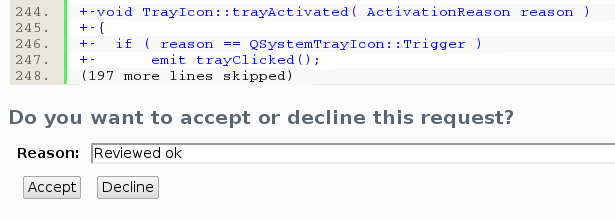
Accepting a submitrequest from the web client

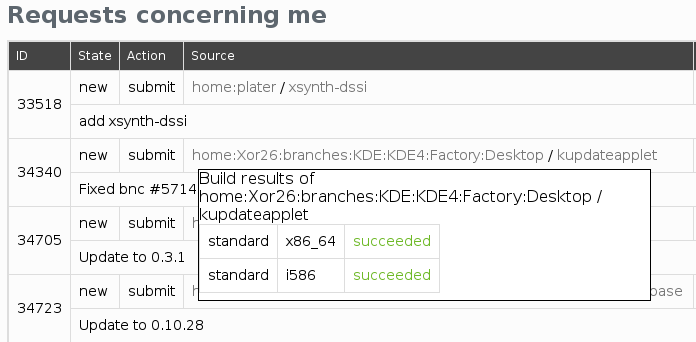
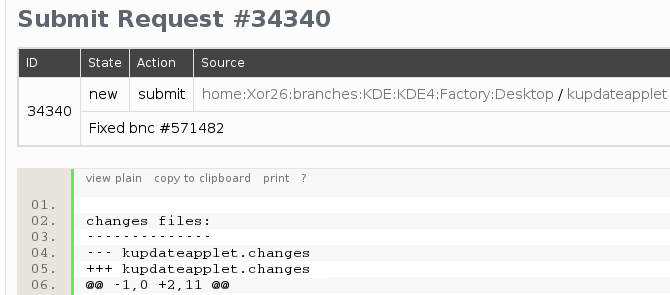
The Boosters’ sprint resulted in a fully-featured web frontend, where the reviewer can check if a submitted package actually builds, the differences in the request, accept or reject with comment, and also immediately submit the changes onward to openSUSE Factory.

Checking that submitrequests build

Showing the changes in a submitrequest

Showing the changes in a submitrequest

Another focus has been to make the overall process of preparing an openSUSE release easier.  The release manager’s job involves bringing together the output of many Build Service development projects, making sure that they all build, and that they have submitted their latest versions from the development projects to openSUSE:Factory.  This is the Build Service collaboration model.  If packages don’t build for a milestone release, or are not submitted, then the release manager can only take the previous version or choose to exclude a package from the release, which doesn’t help in getting the distribution tested.

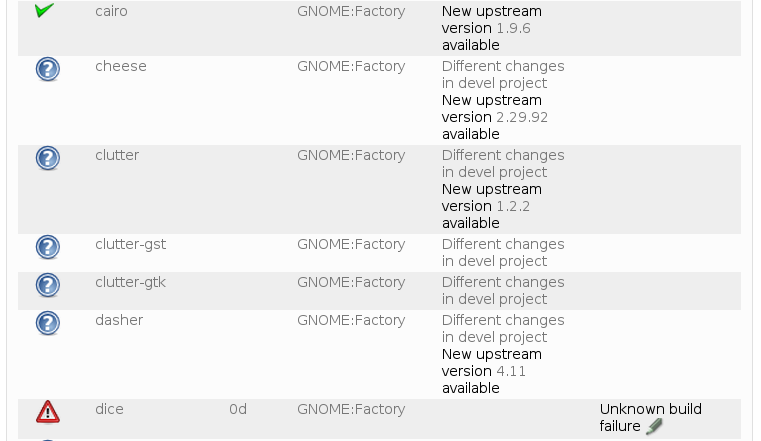
Factory Status showing packages from GNOME:Factory

Factory Status showing progress from GNOME:Factory

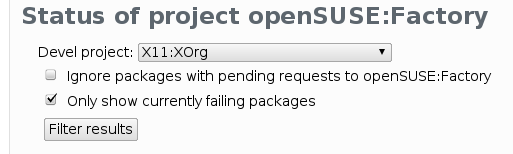
The new project status page gives a project maintainer, for example the openSUSE release manager, a bird’s eye view of what needs to be done in his project: a list of packages that are currently failing; where there is an outstanding submit request, where there are unsubmitted changes in the development project, and where there is a newer version available upstream.  With quick links to projects and packages of interest, and a powerful set of filters, a project maintainer can quickly see where there are problems then drill down into the details.

Filtering problem packages by development project

cd tokamak4; make uninstall && make clean

February 26th, 2010 by

It’s Friday again already and the longest week of my life is over. It’s certainly been one of the most inspiring. Seeing nearly thirty expert KDE developers hammering out reams of code, artwork and design all over the workspace and further down the stack at all hours has been thrilling and has kept me serving their needs better than any amount of caffeine.

Now Tokamak 4 is over.  The last few visitors are leaving and I’ve been calling taxis, tidying out the offices and dismantling networks.  I’m looking forward to seeing the results in improvements to KDE SC 4.5.  Yesterday we made a series of short videos explaining what we’ve been working on that will be published over the course of next week.

Observant readers of this blog’s title will notice that I haven’t deleted the build system.   I’ve learned a lot about organising a large developer sprint and as part of our openSUSE Boosters’ strategy we expect to be hosting more such developer meetings for upstream projects in order to make improvements directly to the software we distribute.  We strongly believe that using our facilities to allow upstream to do the great things they want to do creates benefits both for openSUSE, and in a snowball effect for the wider Free Software universe.  So I’m documenting what works and what doesn’t on the openSUSE wiki in order to make next sprint we host here come off even more successfully and smoothly.

As for me, I’m looking out the window at a Bavarian lake and taking it easy this weekend.  As always, Have A Lot Of Fun…

Hot Off The openSUSE Build Service Press

January 27th, 2010 by

Now with the aid of the Hermes notification system, you can find out as soon as a new version of software you’re interested in is uploaded to the openSUSE Build Service.

KDE version updates shown in the News widget

Here we see the test KDE feed I setup in the News widget.  You can setup your own new version feeds by going to the Hermes web interface with your openSUSE login, My Subscriptions, then scroll to the bottom of the page and enter the ‘expert interface’.  Add a new subscription of message type ‘OBS_SRCSRV_VERSION_CHANGE’ then set the appropriate digest period and the delivery mode to Web/RSS Newsfeed.  Finally add a Filter for ‘packagename’ and probably ‘containsitem’ then some part of the project name you are interested in.  I used ‘KDE:’ for the above feed, but you could use a more complete project name to include only for example new versions in KDE:KDE4:Factory:Desktop.  Save your changes, and you can then go to the ‘My Feeds’ link in the Hermes toolbox at left to get the feed URL.  To add a feed name, edit the notification and add a description.

Now all you research students and other compulsive update fans needn’t ‘zypper dup’ 10 times a day to find out if your favourite software changed.  Enhancement #434757 is done!

update from the openSUSE Boosters

October 21st, 2009 by

While openSUSE 11.2 gets closer and closer, all of the Boosters are mostly busy making sure RC1 and the final release are good.  But we’re finding some time to work on our Boosting projects.  On the umbrella site for all opensuse.org sites front, a design and user profiles are being developed .  The factory.opensuse.org status site concept is being developed in collaboration with the Maintenance team, so that it will be used for seeing the state of maintenance work (ie online updates) for released openSUSE versions.  We’re analysing the Build Service web client code for how to hook in there, and several team members are brushing up their Ruby skills.  The reorganize contributor documentation squad are discussing a new structure on the opensuse-wiki mailing list.

If you have any feedback on these ideas you can find us on the opensuse-project mailing list or on -wiki as above.  If you want to help out, we’ll be using opensuse-boosters@opensuse.org in future.

Busily,

The Propaganda Minister