openSUSE Lizards

Authors
Adam Jurkiewicz
Adrian Schröter (5)
Agustin Chavarria (1)
Akhil Laddha
Alex Barrios
Alex Minton
Alexander Naumov
Alexander Orlovskyy (3)
Alexey Eromenko
Alin M Elena (4)
Andrea Florio (14)
Andreas Jaeger (44)
Andreas Stieger (1)
Andreas van dem Helge
Andrej Semen
Andrew Wafaa (25)
Arvin Schnell (6)
Beineri2
Bernhard Wiedemann
Bharath Acharya
Bonnie Kurniawan
Brian G. Merrell
Bruno Friedmann
Carl Fletcher
Casual Programmer
Chang ChiaChin
Christoph Thiel
Christopher Hobbs (15)
Ciaran Farrell (2)
Claes Backstrom
Coly Li
Cristian Rodríguez
Daniel Bornkessel
David Bailey
David C. Rankin
Dean Hilkewich
Dinar Valeev (5)
Dirk Müller (1)
Dmitry Serpokryl (7)
Duncan Mac-Vicar
Enrique Herrera Noya
Eugene Pivnev
FabioMux (1)
Federico Lucifredi
Frank Lee
Gabriele Mohr
Gerrit Beine
Helman Rene Taleno Martinez
Helmut Schaa
Henne (6)
Herbert Graeber
Holgi (2)
Hubert Mantel (1)
Ioan Vancea
J. Daniel Schmidt (1)
Jaime Andrés Vélez Osorio
James Tremblay (7)
Jan Blunck (4)
Jan Loeser (1)
Jan Madsen (1)
Jan Nieuwenhuizen
Jan-Christoph Bornschlegel (3)
Jan-Simon Möller (19)
Javier Llorente (2)
Jigish Gohil (22)
Jiri Srain (1)
Jiří Suchomel (1)
Johan Kotze (5)
John Terpstra
Joop Boonen
José Oramas
Josef Reidinger (8)
Juergen Weigert (1)
Julio Vannini (7)
Justin Haygood
Kálmán Kéménczy
Kayo Hamid
Kevin Yeaux (10)
Klaas Freitag (21)
Klara Cihlarova
Klaus Kämpf
Klaus Singvogel
kl_eisbaer (10)
Lars Marowsky-Bree
Li Bin
Ludwig Nussel (6)
M. Edward (Ed) Borasky
M. Edwin Zakaria
M. Hill
Manuel Trujillo
Marcos David
Marcus Hüwe (8)
Marcus Meissner (1)
Marcus Moeller (1)
Marcus Schaefer (3)
Martin Lasarsch (8)
Martin Mohring (8)
Martin Schmiderer
Martin Schmidkunz
Masim "Vavai" Sugianto (20)
Matt Sealey
Mauro Parra-Miranda
Michael Andres (1)
Michael Löffler (3)
Michael Skiba
Michal Marek (3)
Michal Vyskocil (9)
Michal Zugec
Miguel Angel Barajas Hernandez
Mingxi Wu
mrdocs
Nikanth Karthikesan (2)
Oprea Lucian
Oswin Zulu
Peter Nixon
Peter Pöml (4)
Petr Mladek (32)
Petr Uzel (2)
Philipp Thomas
Pragnesh Radadiya
Raul Libório
Ravi Kumar
Ray Chen
Ray Wang (1)
Renato de Pontes Pereira
Ricardo Chung
Ricardo Varas Santana (6)
Richard Bos (5)
Robert Lihm
Roland Haidl
Roman Drahtmueller
Rossana Motta (1)
Rupert Horstkötter (10)
Sascha Manns (45)
Savin Alex V.
Sebastian Schöbinger (4)
Stanislav Visnovsky (7)
Stefan Haas (1)
Stefan Hundhammer (5)
Stefan Schubert (3)
Steffen Winterfeldt (4)
Stephan Kulow (10)
Suman Manjunath
Suresh Jayaraman (1)
Susanne Oberhauser (2)
Syamsul Qamar Ngabito
Thomas Göttlicher (4)
Thomas Jones
Thomas Schraitle (15)
Thruth Wang
Tuukka (11)
Ulrich Hecht
Vincenzo Barranco
Wilken Gottwalt
Will Stephenson (1)
Xin Wei Hu
Yuri Tsarev


Writing first YCP program

1 Star2 Stars3 Stars4 Stars5 Stars (7 votes, average: 3.43 out of 5)
Loading ... Loading ...
Friday, February 13th, 2009 by Alexander Orlovskyy Digg!

Hi folks!

It was a long time since my last blog. ;)

Today, i will show you my first program, it`s a simple test program which shows basic functions of YCP

Let`s start!!

first of all, you need all core development YaST and QT packages

(All mentioned bottom steps, can be made with normal user )

second , you must create a  symlink to /usr/lib/YaST2/bin/y2base

$ ln -s <destination> <linkname>

(In my case name of symlink is y2base.)

third , you need two console`s , one for program writing and one for monitoring .y2log (where you can see all debug messages)

if you wish more detailed debug output during root session, than type in console following :

$ su

$ export Y2DEBUG=1

$ exit

(switching back to normal user)

Ok, lets see the code of PushButton.ycp !

{
// Build a dialog with one button and two labels.
// Wait until that button is clicked,
// then close the dialog and terminate.

UI::OpenDialog( `VBox(
`Label(`opt(`boldFont),”PushButton TEST!!!!!!!!”),
`PushButton( “&OK” ),
`Label(`opt(`boldFont),”JUST SIMPLE TEST”)
)
);

UI::UserInput();
UI::CloseDialog();
}

Than:

$ chmod 765 PushButton.ycp

After you have written the program  , type in the console:

$ ./y2base ./PushButton.ycp qt

You will get following window:
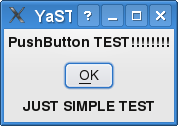
PushButton

What is amazing at YCP, that this code can be interpreted into ncurses

Try following command:

$ ./y2base ./PushButton.ycp ncurses
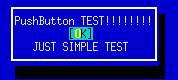
Result:

You have written only one code , which can be used in two different gui environments graphical and  text mode!

In my next blog i will write about creating own SCR Agent.


7 Comments

Comment by Robin
2009-02-13 11:36:06

> $ su
> $ export Y2DEBUG=1
> $ exit

That does exactly… nothing.

Exporting variables only affects child processes

 
Comment by Alexander Orlovskyy
2009-02-13 12:00:31

Hi Robin, please refer to YaST manual
“The y2logs don’t seem to show my problem. Can that logging be made any more verbose?”

http://en.opensuse.org/Bugs/YaST

 
Comment by Robin
2009-02-13 13:34:41

sure, but exporting a variable and exiting immediately afterwards does nothing.

from the wiki:

export Y2DEBUG=1
yast2

That would start yast2 with the Y2DEBUG variable set to 1.
export Y2DEBUG=1
exit
will set the variable and exit the shell which just discards the variable.

You might want this:
export Y2DEBUG=1 # once in your shell session

./y2base ./PushButton.ycp qt

 
Comment by Alexander Orlovskyy
2009-02-13 14:12:11

Robin,i understand , i edited my blog ,so now it makes sense. ;-)
Don`t forget,i still learning .

 
Comment by Robin
2009-02-13 15:17:42

well, you never stop learning when using linux, that’s why I love it

 
Comment by Martin Vidner
2009-02-19 11:51:50

You can also do it without the symlink: yast2 --qt ./PushButton.ycp, yast2 --gtk ./PushButton.ycp, yast2 --ncurses ./PushButton.ycp

And if people got interested, here’s a page with useful links about YaST development

Comment by Martin Vidner
2009-02-19 11:53:18

Ugh, I forgot. If you are not root, you will need to call it with the full path: /sbin/yast2 ...


Sorry, the comment form is closed at this time.